
If you are wondering how to get to Quy Nhon, the journey is easier than the destination’s quieter reputation might suggest. Most international travelers arrive by flying through Hanoi or Ho Chi Minh City, taking the north–south railway to Dieu Tri Station, or traveling overland from another Central Vietnam destination.
The important part is choosing the right arrival point. Quy Nhon’s airport is Phu Cat Airport (UIH), around 30–35 kilometres from the central area, while most long-distance trains stop at Dieu Tri Station outside the city. Updated maps may also show Quy Nhon in Gia Lai Province rather than Binh Dinh: former Binh Dinh and Gia Lai provinces were merged in 2025, although older travel information still commonly uses the Binh Dinh name.
Quy Nhon Transport at a Glance
For first-time visitors, the best option usually depends more on where you are coming from than your overall Vietnam itinerary.
| Starting point | Usually the most practical option | Approximate journey | Main arrival point |
| International destination | International flight + domestic connection | Depends on connection | Phu Cat Airport |
| Hanoi | Direct flight | About 1 hr 35–40 min | Phu Cat Airport |
| Ho Chi Minh City | Direct flight | About 1 hr 10 min | Phu Cat Airport |
| Da Nang | Train or private car | About 5–6.5 hours | Dieu Tri / Quy Nhon |
| Hoi An | Private car or bus | About 5.5–7 hours | Quy Nhon |
| Nha Trang | Train or road transfer | Around 4–5 hours | Dieu Tri / Quy Nhon |
As of September 2026, scheduled nonstop flights into Phu Cat Airport operate from Hanoi and Ho Chi Minh City. Current railway timetables place Dieu Tri on the main north–south route, while recent Hoi An route information puts the overland journey at roughly 5.5–7 hours depending on transport.

Private car transfer
Fly to Phu Cat Airport for the Fastest Journey
For most travelers arriving from overseas, flying is the simplest answer to how to get to Quy Nhon. Phu Cat Airport uses the airport code UIH, which is the code you should enter when searching for flights.
As of September 2026, the airport has scheduled nonstop services from Hanoi and Ho Chi Minh City rather than international nonstop routes. Travelers arriving from Europe, Australia, North America or elsewhere in Asia therefore normally connect through one of these Vietnamese gateways.
A flight from Ho Chi Minh City takes around 1 hour 10 minutes, while Hanoi flights generally take about 1 hour 35–40 minutes. Actual flight schedules and frequencies change seasonally, so it is better to check your airline before building a tight connection.
Landing at UIH does not mean you are already in downtown Quy Nhon. Vietnam Airlines currently places the airport roughly 30–35 kilometres from the city, with road transfers often taking around 50–60 minutes depending on traffic and destination. Taxis, pre-arranged private transfers and app-based cars are practical options, while local shuttle arrangements should be reconfirmed when you travel.

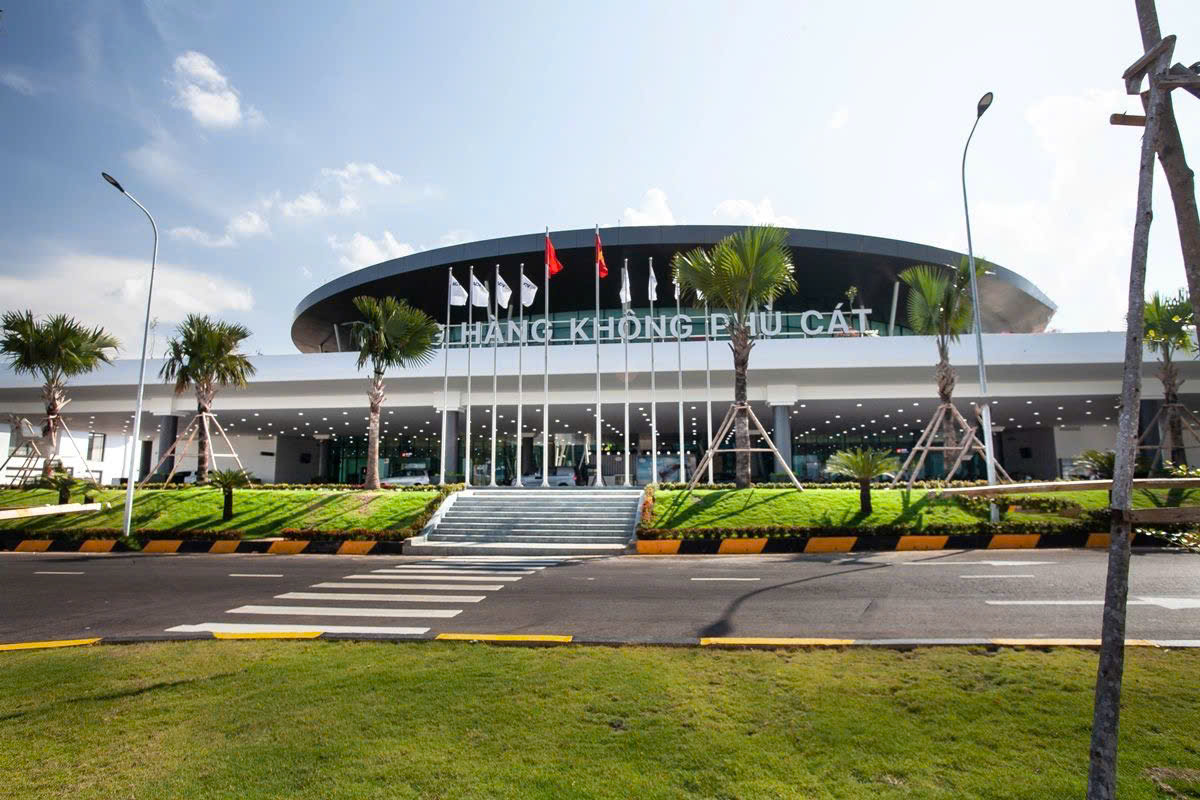
Phu Cat Airport – The main airport serving domestic and international flights to Quy Nhon.
Take the Train to Dieu Tri Station for a Slower, Scenic Arrival
Train travel suits visitors who want to see more of Vietnam rather than simply move between airports. The key detail is to search for Dieu Tri Station, because the main Reunification railway services use Dieu Tri as the practical gateway for Quy Nhon.
Vietnam Railways lists both Dieu Tri and Quy Nhon stations, but its principal north–south timetable shows long-distance SE trains stopping at Dieu Tri. The station lies roughly 11 kilometres by road from central Quy Nhon, making the final transfer relatively short.
From Da Nang, current long-distance train schedules generally put the journey to Dieu Tri around five and a half to six and a half hours. Coming north from Nha Trang is shorter, with several scheduled services completing that section in roughly four hours.
A soft air-conditioned seat works well for these daytime journeys, while a sleeper berth makes more sense from Hanoi or Ho Chi Minh City. When booking, check both the station name and arrival time carefully, especially if your train reaches Dieu Tri late at night.

Dieu Tri Railway Station (Source: Collected)
Travel Overland from Da Nang, Hoi An or Nha Trang
Road travel becomes attractive once you are already exploring Central Vietnam. Da Nang, Hoi An and Nha Trang are close enough that flying often adds unnecessary airport transfers and waiting time.
From Da Nang, trains and private cars generally take around five to six hours, depending on the service and road conditions. Current flight schedules do not show a nonstop Da Nang–Phu Cat route, making overland travel especially logical for this section of your itinerary.
Hoi An is slightly different because a direct road journey avoids the extra transfer involved in reaching a railway station first. Recent route information estimates roughly 5.5–7 hours between Hoi An and Quy Nhon, with private transport providing the easiest door-to-door journey.
Nha Trang is particularly convenient by train because both destinations sit along Vietnam’s north–south railway corridor. If you prefer flexibility, a private car lets you stop around coastal Phu Yen rather than watching the landscape pass from a carriage window.

Da Nang Golden Bridge
Bus, Limousine Van or Private Car: Which Should You Choose?
Sleeper buses and limousine vans are useful for travelers watching their budget, especially on regional routes. They can also save a hotel night when traveling a longer distance from Ho Chi Minh City.
The compromise is predictability. Bus departure points, drop-off locations and schedules can change, while a stop described as “Quy Nhon” may not be beside your accommodation.
Private transport costs more but removes much of that uncertainty. It works particularly well for families, small groups, travelers carrying large luggage, or anyone staying outside the central beachfront area.
For Da Nang or Hoi An, a private car also gives you freedom to stop for meals or short breaks along the coast. For Nha Trang, compare the car against a daytime train before deciding, since the railway journey is already relatively straightforward.

Train from Ho Chi Minh to Quy Nhon – best for slow travel (Source: Collected)
Plan the Final Transfer Before You Arrive
The last part of the journey is easy to overlook when researching how to get to Quy Nhon. Your hotel may be in central Quy Nhon, but it could also be farther south near Bai Xep or northeast toward fishing villages and island departure points.
From Phu Cat Airport, allow roughly an hour before assuming you will be checked into a central hotel. From Dieu Tri Station, central Quy Nhon is only about 11 kilometres away, although actual travel time depends on traffic and your accommodation location.
Save your hotel name, Vietnamese address and Google Maps pin before traveling. This is especially useful when a driver recognizes the Vietnamese place name but not its English version.
Grab currently operates around Quy Nhon and can be useful for city journeys and some airport transfers, although vehicle availability varies. A pre-arranged transfer is worth considering after a late arrival, with young children, or when heading directly to a resort outside the center.

Quy Nhon Car Rentals (Source: Collected)
Recommended Areas to Stay After Arriving in Quy Nhon
Central Quy Nhon and the Beachfront
Best for: First-time visitors, food lovers and short stays.
Staying near the central beachfront keeps restaurants, cafés, local services and evening walks within easy reach. It is also a practical base if you plan several different day trips rather than focusing on one beach or island.
For a first visit, this location reduces the amount of additional transport needed after arriving. You can settle in first, then decide whether to explore the coast, Cham heritage or nearby fishing communities.

City Hotel
Bai Xep
Best for: Couples, slower travelers and visitors looking for a quieter coastal stay.
Bai Xep is a small fishing-village area south of central Quy Nhon, approximately 10 kilometres from the city. The atmosphere is noticeably quieter, so it suits visitors who prefer staying near the sea rather than city restaurants and nightlife.
If you are heading straight there from Phu Cat Airport or Dieu Tri Station, give your driver the exact property rather than simply saying “Quy Nhon.” Your final transfer will be longer than for a hotel in the center.

Anantara Resort – best resort in Quy Nhon
Nhon Ly and Nhon Hai
Best for: Ky Co, Eo Gio, Hon Kho and early-start sea activities.
These coastal communities are useful bases when beaches, snorkeling and fishing-village scenery matter more than downtown convenience. Nhon Ly is commonly associated with access toward Ky Co and Eo Gio, while Hon Kho trips typically use the Nhon Hai fishing area.
They are less convenient for travelers planning frequent evenings in central Quy Nhon. For a short first trip, many visitors prefer staying centrally and visiting these areas as day excursions.

Homestay in a Fishing Village (Source: Collected)
Recommended Thich Tours Experiences
Once the transport is sorted, the most useful tours are those that help first-time visitors understand Quy Nhon without immediately committing to a packed schedule.
WHISPERS OF QUY NHƠN TWIN TOWERS HERITAGE MINI TOUR
This half-day experience works particularly well on an arrival day when you want something meaningful without traveling far again. It includes the Twin Cham Towers in central Quy Nhon, local cultural interpretation and hotel pickup, making it suitable for couples, families and culture-focused travelers with limited time.
It is an easy option after settling into a central hotel, especially if a full coastal day feels too ambitious immediately after traveling.

Twin Towers in Quy Nhon City Center – group photo
QUY NHON COAST LINE MOTORBIKE TOUR
This experience suits solo travelers, couples and adventurous visitors who want to understand how the city connects with the surrounding coastline. The current program combines urban landmarks, Thi Nai Bridge, Phuong Mai Peninsula, coastal scenery and Banh It Cham Towers.
Guests can ride as passengers with local drivers, so previous motorbike experience is not required. Operations remain weather-dependent, making it sensible to check conditions before confirming.

Amazing Con Chim looks from above
Hon Kho Snorkeling & Island Tour – Unveiling Nature’s Purest Beauty
This is a stronger choice once you have a full free morning rather than immediately after arrival. The current itinerary includes hotel pickup, boat transport, snorkeling, SUP paddling and time around Hon Kho’s coastal environment.
It suits travelers who came to Quy Nhon primarily for beaches and marine scenery. Because boat activities depend on sea conditions, check availability close to your travel date rather than building an inflexible itinerary months ahead.

Hon Kho Beach
FAQ – Frequently Asked Questions
What airport should I fly into for Quy Nhon?
Fly to Phu Cat Airport (UIH), the airport serving Quy Nhon. It is roughly 30–35 kilometres from the central area.
Are there direct international flights to Quy Nhon?
As of September 2026, scheduled nonstop services at Phu Cat Airport are domestic, from Hanoi and Ho Chi Minh City. International travelers normally connect through one of these airports.
Which train station should I choose for Quy Nhon?
Choose Dieu Tri Station for most long-distance north–south trains. It is about 11 kilometres by road from central Quy Nhon.
Is it better to travel from Da Nang to Quy Nhon by train or plane?
Train or private car is usually more practical because current schedules do not show nonstop Da Nang–Quy Nhon flights. Train journeys commonly take around 5.5–6.5 hours.
Do I need to book my Quy Nhon airport transfer in advance?
Not always, but advance booking is useful for late arrivals, families, larger groups or accommodation outside central Quy Nhon. Otherwise, taxis and app-based transport may be available after landing.
Conclusion
Choosing how to get to Quy Nhon becomes simple once you know the two names that matter: Phu Cat Airport for flights and Dieu Tri Station for trains. Fly when time matters, take the train for a slower Central Vietnam journey, or travel by road when Quy Nhon forms part of a Da Nang–Hoi An–Nha Trang itinerary.
Once your arrival is arranged, keep the first day flexible and explore Quy Nhon at an easier pace. If you would rather connect transport, accommodation and local experiences into one itinerary, you can also ask the local team to suggest a route around your arrival time and travel style.