
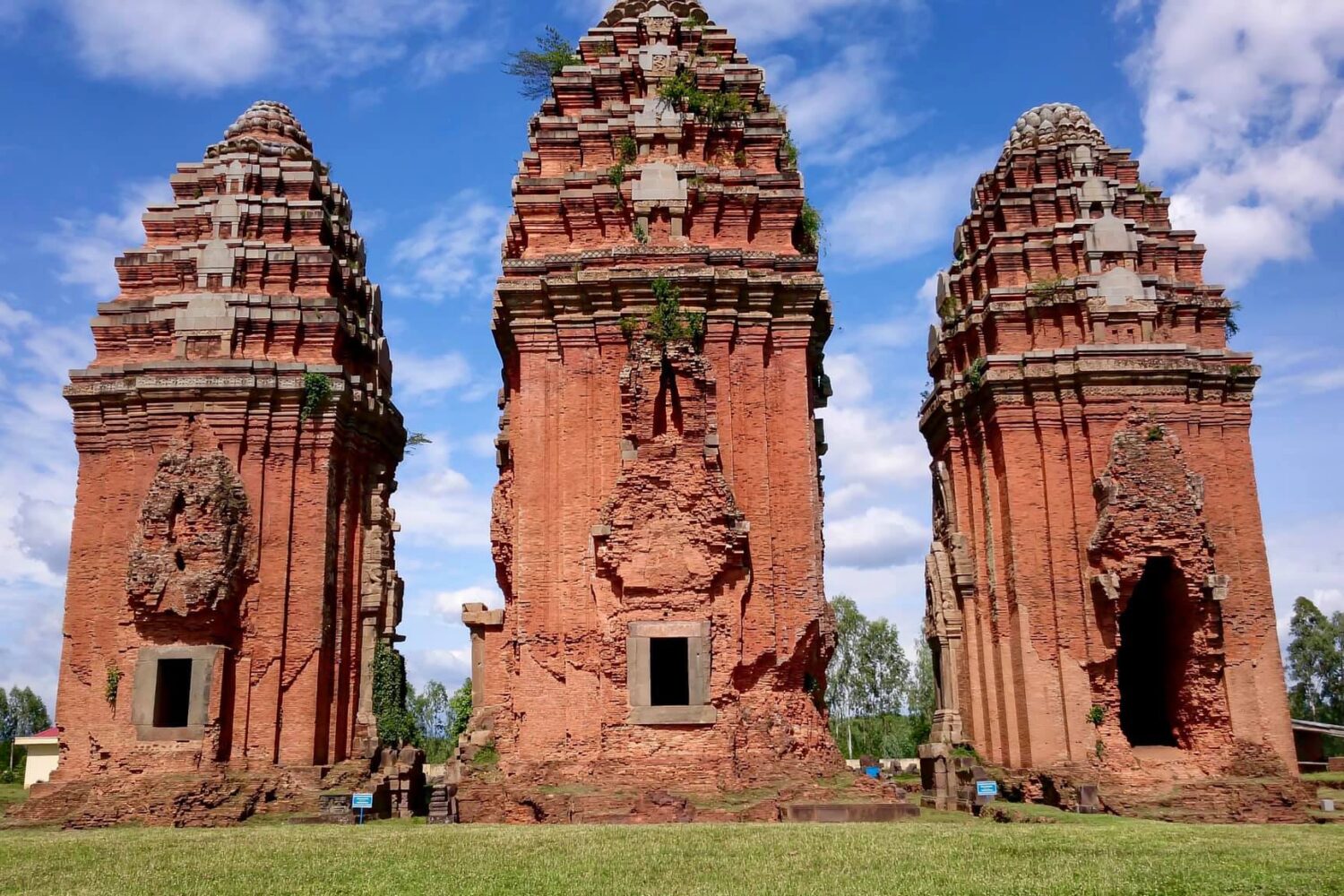
If you want to see one of the most remarkable Cham monuments beyond central Quy Nhon, Duong Long Towers is well worth the journey inland. The three brick-and-sandstone towers rise dramatically above the surrounding countryside, offering a very different experience from the beaches and coastal viewpoints most travelers associate with Quy Nhon.
For first-time international visitors, Duong Long is especially rewarding because there is much more to notice than three ancient structures. The architecture reveals connections between Champa and neighboring cultures, while archaeological discoveries help explain how the complex was built and used.
This guide covers the history, architecture, carvings, religious meaning, transport from Quy Nhon, practical visiting tips, and nearby places worth combining with your trip.
Why Duong Long Towers Are Special
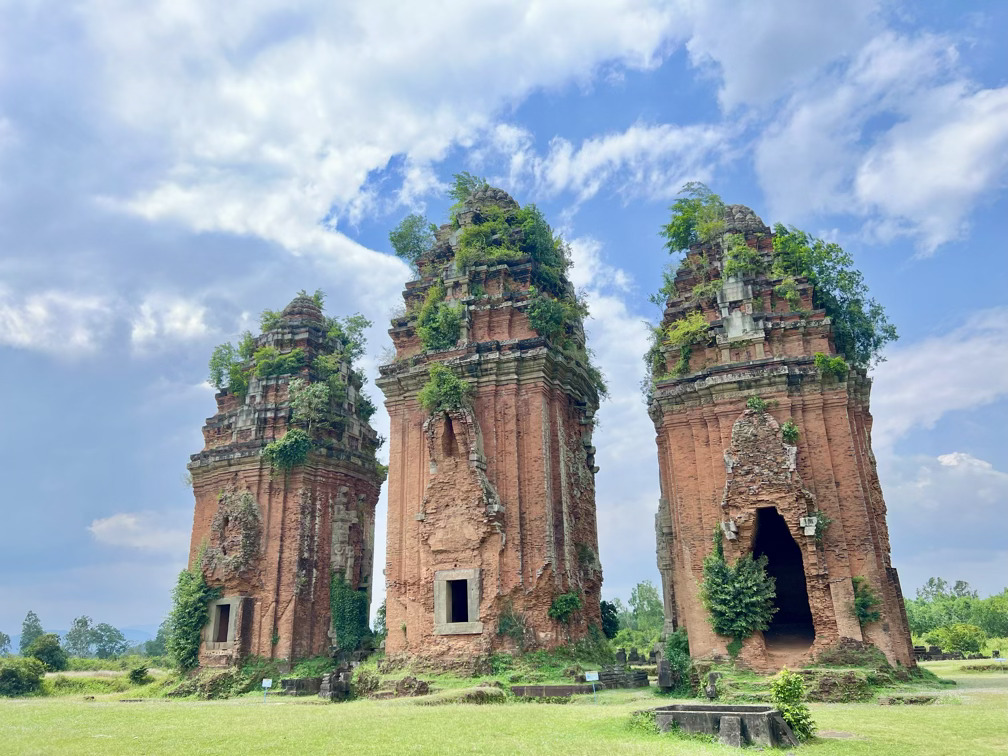
Duong Long consists of three Cham towers arranged closely along a north–south axis. The complex was built around the late twelfth to early thirteenth century, during the Vijaya period of Champa.
Champa was a historical kingdom closely associated with the Cham people and once controlled substantial areas along what is now central Vietnam. Around Quy Nhon and the former Binh Dinh region, surviving towers, citadels, sculpture, and archaeological sites still reveal traces of this period.
Duong Long stands out particularly for its scale. The central tower reaches almost 39 metres, making the group considerably more monumental than many visitors expect before arriving.
The complex was recognized as a Special National Monument of Vietnam in 2015, reflecting its architectural, historical, and artistic significance.
Duong Long Champa towers
A Cham Monument Shaped by Regional Exchange
One of the most interesting aspects of Duong Long Towers is the way the architecture reflects cultural exchange rather than a completely isolated architectural tradition.
The heritage authority describes the site as combining traditional Champa architecture and sculpture with influences from Khmer art. Those connections make sense within a period when kingdoms across mainland Southeast Asia interacted through diplomacy, conflict, religion, and artistic exchange.
Yet Duong Long should not simply be understood as an imitation of Cambodian monuments. Researchers have pointed to distinctly Cham interpretations of forms also seen elsewhere in the region.
Naga serpent sculptures provide a good example. Some excavated Naga figures have rounded bodies covered with carefully carved scales, differing from smoother serpent forms found at Angkor.
Such details are useful because they show how Cham artisans absorbed outside influences while adapting them to local artistic traditions. Duong Long therefore tells a broader story about how architecture evolves through contact between cultures.
Reading the Three Towers
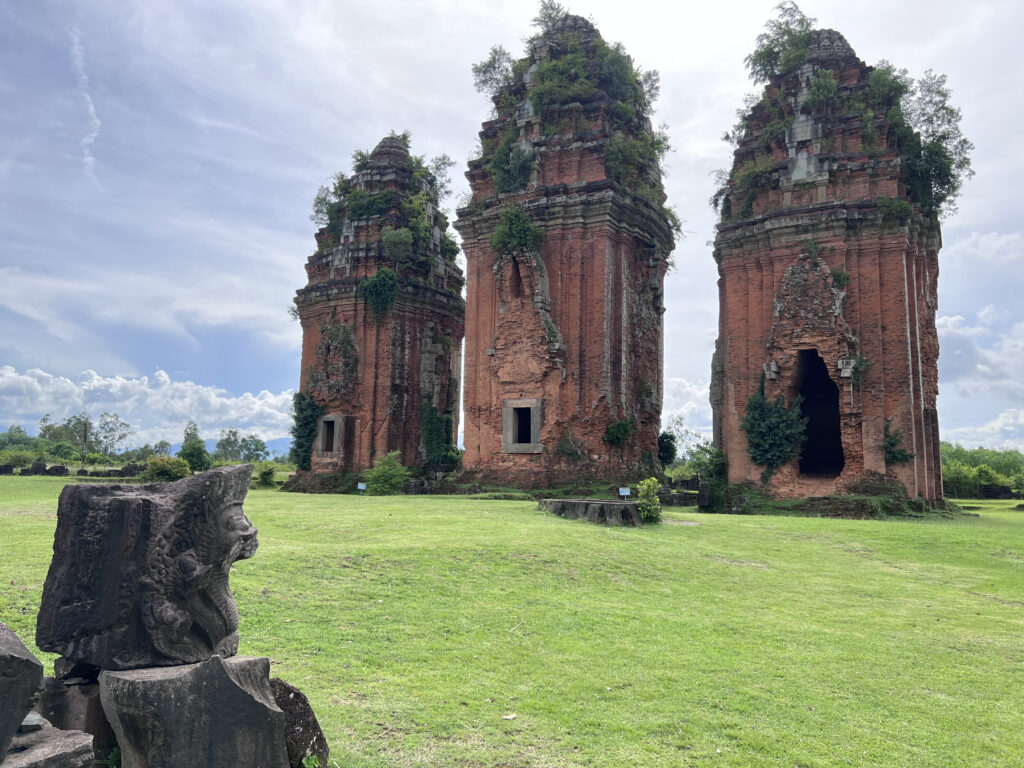
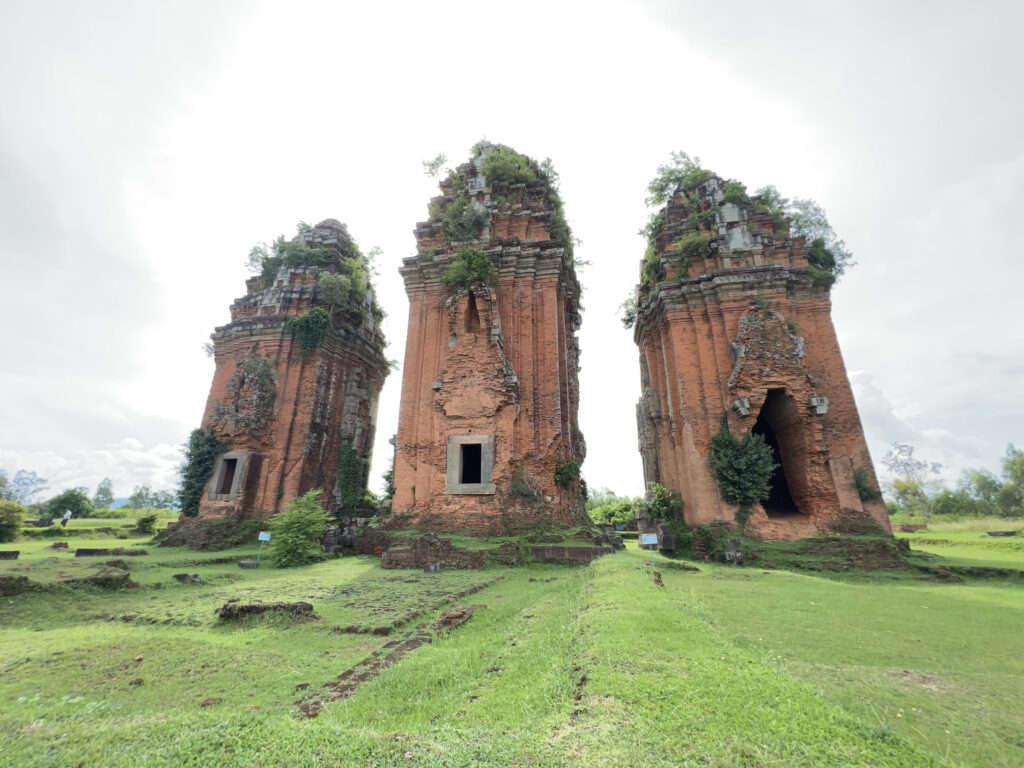
The three towers look similar from a distance, but each preserves different architectural details. Taking time to walk around the group makes the visit considerably more interesting.
Brick forms most of the structural walls, while sandstone was used extensively around bases, entrances, roof bands, and decorative elements. Archaeological work has revealed just how important stone sculpture was to the original appearance of the complex.
Duong Long Champa towers
The Central Tower: Height and Contrasting Surfaces
The central tower dominates the complex at 38.81 metres, according to the official heritage inventory. Its square base measures approximately 16.5 metres on each side.
Much of the brick wall surface appears relatively restrained, divided by broad vertical projections rather than dense decoration. This simplicity makes the surviving sandstone details around the lower and upper sections stand out more clearly.
Walk several metres away from the tower before looking upward. From that distance, the contrast between the broad brick surfaces and the more intricate stone elements becomes easier to see.
Parts of the entrances and false doorways have been damaged or lost over time. However, enough remains to understand the immense scale and carefully balanced proportions of the original structure.
The South Tower: Elephant Heads and Lion Bodies
The south tower stands 32.94 metres high and is considered the best-preserved of the three towers. Its base is approximately 14 metres wide.
One detail worth looking for is the Gajasimha motif decorating the roof band. These mythical creatures combine an elephant’s head with a lion’s body and appear repeatedly as part of the architectural ornamentation.
They are not a row of separate statues placed beside the tower. Instead, the figures are integrated directly into the stone decoration beneath the roof.
The south tower also retains parts of its sandstone doorway. Looking closely at these surviving elements gives a better sense of how brick construction and stone carving originally worked together.
The North Tower: Serpents and Seated Figures
The north tower rises 31.76 metres and has suffered more damage than the other two structures. Restoration and stabilization work has helped preserve what remains.
Its decoration includes lions and pointed arches formed by serpentine bodies. Within some of these compositions, human figures appear seated with crossed legs.
The southern false doorway is another feature worth noticing. A false doorway looks like an entrance but does not actually provide passage into the tower.
Surviving stone pillars and decorative elements around this doorway provide useful clues to the original appearance of the monument.

Aerial view of the three ancient Duong Long Cham Towers surrounded by countryside in Gia Lai, near Quy Nhon.
Stone Carvings That Reveal More Than Decoration
Duong Long becomes much more interesting once you stop thinking of its carvings as decoration alone.
Archaeological excavations uncovered large numbers of sandstone architectural blocks and sculptures. Recorded finds include depictions of Hindu deities, Naga serpents, Makara creatures, Kala faces, animals, human figures, and lotus motifs.
Gods, Serpents, and Lotus Petals
Among the most significant discoveries is a relief depicting Brahma, an important deity in Hindu tradition. A major Brahma relief associated with Duong Long was found near the north tower and is considered an important example of late Champa sculpture.
Excavations have also revealed numerous Naga serpent sculptures. Duong Long is particularly notable for the quantity and variety of Naga imagery found around the site.
Makara, mythical aquatic creatures associated with South and Southeast Asian religious art, also appear among the recovered material. Lotus petals, animals, deities, and human figures further expand the range of imagery.
These archaeological discoveries provide valuable context when examining the surviving structures. However, excavation records should not be treated as a current exhibition list.
Not every sculpture recovered at Duong Long will necessarily be displayed beside the towers when you visit. Some important objects are preserved in museum collections, so check current displays if a specific artifact interests you.
An Unfinished Pattern and a Clue to Construction
One of the quieter details at Duong Long is also one of the most revealing.
The heritage inventory records unfinished decorative patterns on sandstone blocks around the base of the central tower. Researchers interpret this as evidence that artisans carved some decoration after the stone blocks had already been installed.
This changes how you look at the monument. Rather than imagining every ornament arriving at the construction site fully completed, you can picture craftsmen continuing their work directly on the assembled structure.
When walking around the base, notice differences in the depth and completeness of the carvings. Unfinished details can sometimes tell as much about ancient building techniques as the most elaborate completed sculpture.
What Archaeology Reveals About Worship
Duong Long was not built simply as a monumental landmark. Archaeological finds help place the complex within the religious world of Champa.
A yoni, a ritual pedestal associated with Hindu worship, was discovered during archaeological work west of the main tower group. Researchers connected the find with the worship of Shiva, one of Hinduism’s principal deities.
In Cham religious architecture, a yoni was commonly associated with a linga, together representing an important form of Shiva worship. The discovery therefore provides stronger evidence for understanding the spiritual function of the complex.
Excavations also identified traces of additional brick structures around the three surviving towers. Heritage researchers believe these structures formed part of the wider architectural complex and may even predate the three principal towers.
This matters when imagining Duong Long in its original form. What you see today is only part of a larger sacred landscape that once included additional buildings, sculpture, ritual spaces, and architectural elements.
How to Get to Duong Long Towers from Quy Nhon
Duong Long Towers are located inland from Quy Nhon, roughly 50 kilometres from the city according to local tourism information.
For most international travelers, a private car with driver or an organized cultural tour is the easiest option. The journey gradually leaves the coastal city behind and moves into a more rural landscape associated with the historic heartland of the former Vijaya region.
Older maps and travel articles may list Duong Long under Tay Son District, Binh Dinh Province. Following Vietnam’s administrative changes in 2025, the area is now within Gia Lai Province.
Note: Binh Dinh is the former provincial name. Since July 2025, the area has been part of Gia Lai Province following Vietnam’s administrative reorganization.
Travelers comfortable with Vietnamese roads may also consider going by motorbike. However, first-time visitors should check the route, weather, and road conditions before choosing to self-drive.
Because of the distance from central Quy Nhon, it usually makes more sense to combine Duong Long with another cultural or historical stop rather than travel inland for only a short visit.
Duong Long Champa towers
How Much Time Should You Allow?
For the towers themselves, around 45 to 60 minutes is comfortable for most first-time visitors.
That gives you enough time to walk around all three structures, compare their architecture, examine surviving sandstone details, and take photographs without rushing.
Travelers mainly interested in a quick overview may need less time. Those interested in Champa archaeology, architecture, or photography can easily spend longer examining small details.
Morning is usually a comfortable time for an inland visit, particularly during hotter months. Late afternoon can produce softer light on the brickwork, but you should always confirm current operating hours before planning around sunset.
Bring drinking water, sun protection, and comfortable footwear. Much of the experience takes place outdoors with limited shade around the towers themselves.
Best Places to Combine with Duong Long Towers
A visit works particularly well as part of a wider Champa and inland heritage route.
Banh It Towers
Best for: Architecture, elevated views, and travelers interested in comparing Cham tower styles.
Banh It is one of the most visually rewarding Cham complexes in the wider Quy Nhon region. Its hilltop setting makes the experience very different from Duong Long.
Visiting both helps you see that Cham architecture was not defined by one standard design. Each complex responds differently to its landscape, period, and artistic context.
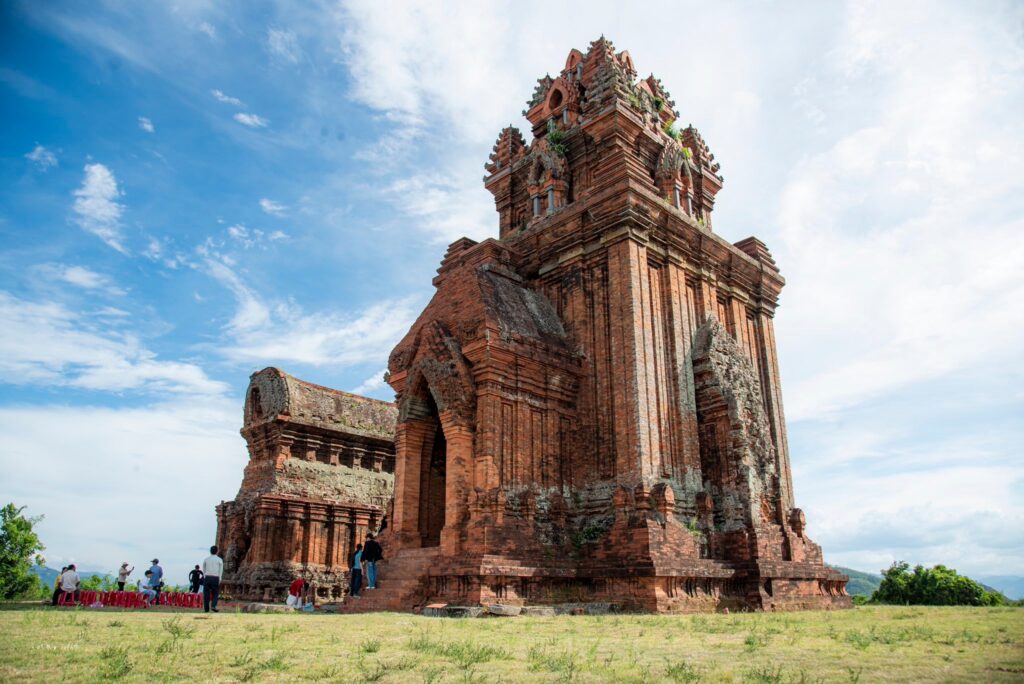
Banh It Champa towers were built in 11 century
Hoang De Citadel
Best for: Travelers interested in Champa’s Vijaya period and later Vietnamese history.
Hoang De Citadel adds a political and historical dimension to a day focused on ancient architecture. The site is associated with the former Cham capital of Vijaya and later became important during the Tay Son period.
Pairing the citadel with Duong Long helps travelers understand the inland area as a former political and cultural center rather than a collection of isolated ruins.

Historic entrance gate in Hoang De Citadel
Quang Trung Museum
Best for: Understanding the Tay Son movement and Emperor Quang Trung.
The museum introduces another major chapter in the region’s history. Its focus is very different from Champa, making it useful for travelers who want a broader historical picture.
Combining Cham heritage and Tay Son history in one inland journey creates a clearer sense of how different civilizations and dynasties shaped the region over time.
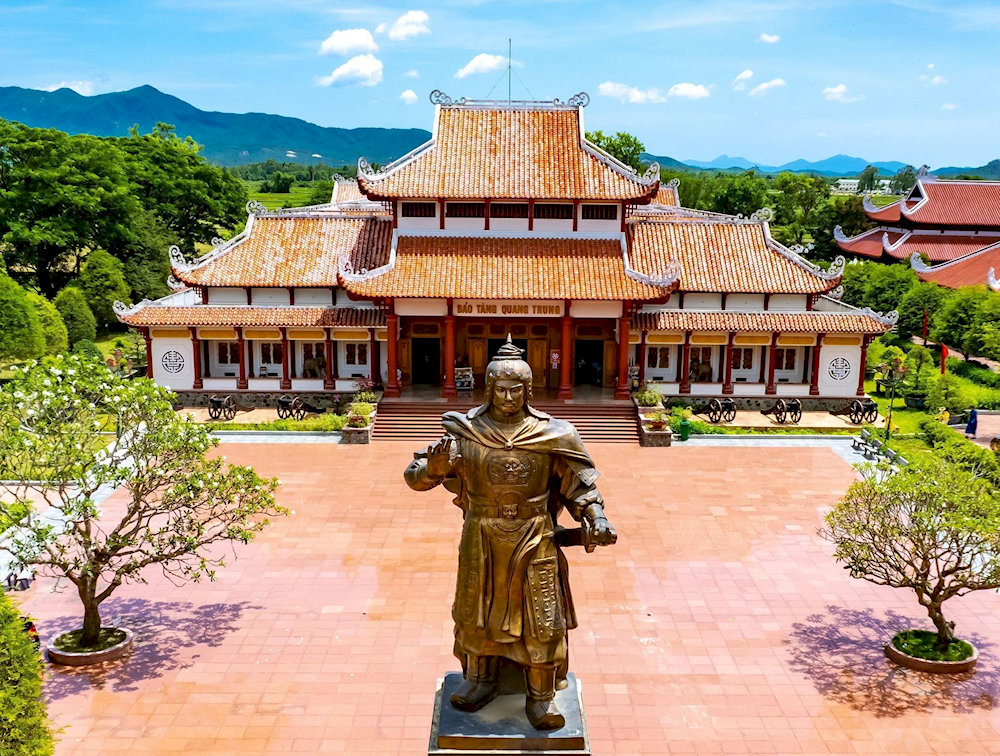
Quang Trung King Statue
Twin Towers in Quy Nhon
Best for: Travelers who want an easy introduction to Cham architecture without leaving the city.
Twin Towers are located within Quy Nhon and are therefore much easier to visit independently.
Seeing them before Duong Long can be especially useful. You arrive at the larger inland complex already familiar with some basic features of Cham tower architecture.
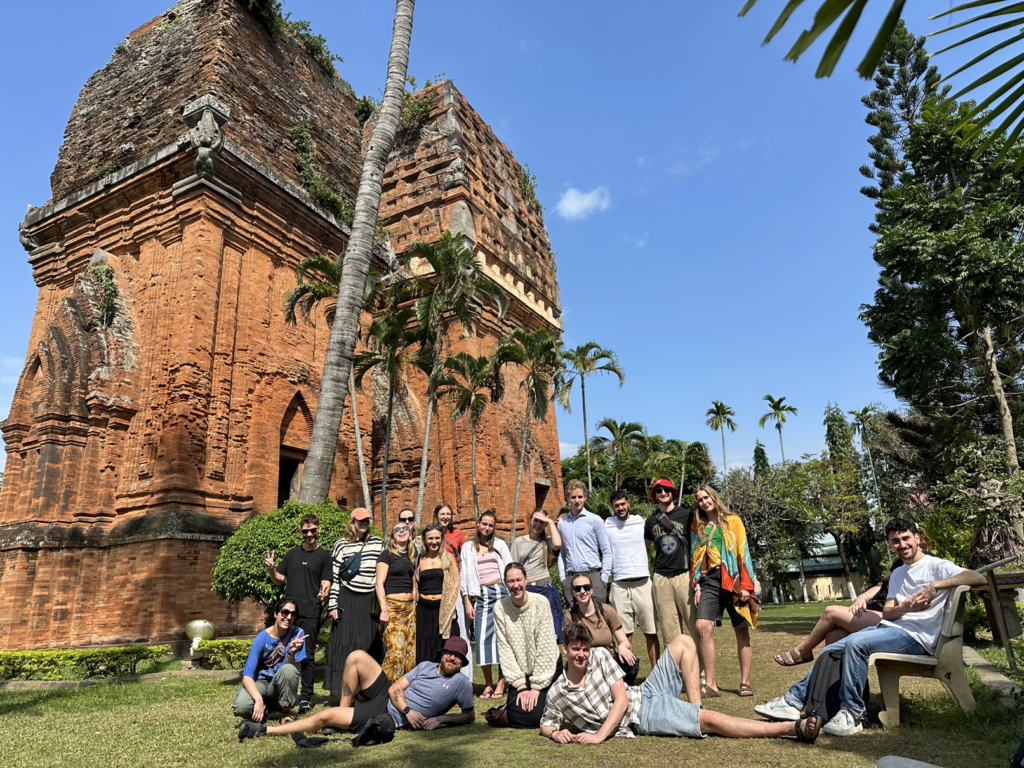
Travelers exploring Thap Doi Twin Towers, one of the remarkable Cham heritage sites in Quy Nhon.
Recommended Thich Tours Experiences
For Duong Long, a guided experience makes particular sense because many of the most interesting details are easy to miss without historical context.
Quy Nhon Champa Tower Tour
This is the most directly relevant Thich Tours option for travelers reading this guide.
The itinerary currently links Twin Towers, Banh It Towers, and Duong Long Towers, allowing visitors to compare three important Cham complexes rather than seeing a single monument in isolation.
It suits history lovers, architecture enthusiasts, photographers, and first-time international visitors who want explanations along the way.
If Duong Long is one of your main reasons for exploring inland from Quy Nhon, this is the tour I would consider first.
>> Discover Half-day Private Tour: Discover 1 day Champa Tower tour in Binh Dinh
The River of Time: Champa Heritage & Handicraft Villages
This tour combines Duong Long Towers with traditional craft experiences, including Phu Gia horse-hat making and Bau Da rice-wine culture.
It is particularly suitable for travelers who want more than archaeological sites and would also like to meet local artisans or understand how regional traditions continue today.
The combination gives the day a broader cultural rhythm: ancient Champa heritage first, followed by living crafts and local food traditions.
>> Discover Half-day Private Tour: The River of Time: Champa Heritage & Handicraft Villages
Quy Nhon Heritage & Local Life Tour
This half-day experience does not travel to Duong Long, but it can work well for visitors with less time.
The current itinerary includes Quy Hoa Village, the local museum, Dam Market, and Twin Towers.
It is best for travelers who want an introduction to Quy Nhon’s history and everyday life without committing to a full inland excursion.
If Duong Long remains your priority, choose one of the first two options instead.
>> Discover Half-day Private Tour: QUY NHƠN HERITAGE & LOCAL LIFE TOUR
FAQ: Duong Long Towers
Is Duong Long Towers worth visiting from Quy Nhon?
Yes, especially for travelers interested in Cham history, architecture, archaeology, or quieter cultural attractions beyond the coast.
How long should I spend at Duong Long Towers?
Around 45–60 minutes is comfortable for most visitors. Allow longer if you enjoy architectural details or photography.
Can I visit Duong Long Towers without a guide?
Yes. However, a knowledgeable guide can help explain features such as false doorways, Naga imagery, Hindu symbolism, and archaeological discoveries that are easy to overlook.
Why do some websites say Duong Long Towers are in Binh Dinh?
Binh Dinh was the former provincial designation commonly used for the site. Following Vietnam’s 2025 administrative reorganization, the area is now part of Gia Lai Province.
What should I combine with Duong Long Towers?
Banh It Towers, Hoang De Citadel, and the Tay Son area are among the most logical additions for a full heritage-focused day from Quy Nhon.
Conclusion
Duong Long Towers reward travelers who take time to look beyond their impressive height. Their brick walls, sandstone sculpture, Hindu imagery, archaeological remains, and regional influences reveal a far more complex story than a quick photo stop suggests.
For first-time visitors, combining Duong Long with other Champa or inland heritage sites is the best way to understand the historical landscape beyond modern Quy Nhon. If you prefer deeper context without arranging transport and individual stops yourself, consider a suitable Champa heritage tour or ask the local Thich Tours team about an itinerary that matches your interests.